
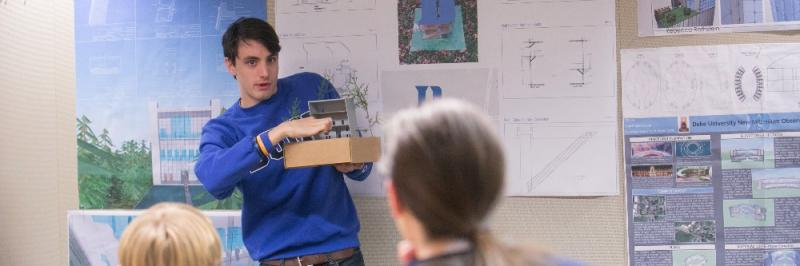
Learn from a practicing architect and experience hands-on design
The curriculum for this certificate provides:
- An understanding of the building design and construction processes
- A close-up examination of current construction projects
- Hands-on projects that simulate work as a member of a professional design team
A background in aesthetic design, architectural history, building materials, and construction forms the architectural core the coursework, while a suitable list of engineering courses in such topics as the structural design provides an engineering basis.
Students working toward Duke's Certificate in Architectural Engineering learn from a practicing architect—Chris Brasier, a fellow of the American Institute of Architects.
Required Courses and Electives
Click below to see more
Note: Requirements differ based on a student's year of matriculation
- Matriculated Fall 2019 and Later
Complete required courses and one (1) elective:
Required Courses
- CEE 311: Architectural Engineering I
- CEE 411: Architectural Engineering II
- CEE 422L: Concrete and Composite Structures
- CEE 423L: Metallic Structures
- ARTHIST 285 or ARTHIST 286 or ARTHIST 103D [Fall 2024, Fall 2023]
Elective Courses
- ARTSVIS 515S: Representing Architecture: Means & Methods [occasionally]
- CEE 421L: Matrix Structural Analysis * see note [Fall]
- CEE 490.01: Calculus of Sustainability [Fall 2022]
- CEE 491/492: Independent Study (On an approved topic)
- CEE 511: Construction Management [even Falls]
- EGR 201L: Mechanics of Solids * see note [Fall and Spring]
- ENVIRON 590: Sustainable Cities & Urban Design [occasionally]
- SUSTAIN 245: Sustainability Theory and Practice [Spring 2024]
Note
This course is not permitted for Civil Engineering majors in the Structural Engineering and Mechanics Track (CE-S/M). Selection would result in exceeding the permissible double-counting.
- Matriculated Fall 2018 and Earlier
Complete required courses and two (2) electives:
Required Courses
- CEE 311: Architectural Engineering I
- CEE 411: Architectural Engineering II
- CEE 422L: Concrete and Composite Structures
- CEE 423L: Metallic Structures
- ARTHIST 285, 285D, or 286D: Modern/Postmodern Architecture
- EGR 201L: Mechanics of Solids
Elective Courses
- ARTSVIS 101: Introduction to Visual Practice
- CEE 201L: Uncertainty Design and Optimization
- CEE 421L: Matrix Structural Analysis
- CEE 190/390: Special Topics in Civil Engineering
- CEE 429: Integrated Structural Design
- CEE 491/492: Projects in Civil Engineering (On a topic in architectural engineering)
- EGR 120L: Introduction to Structural Engineering
- EGR 206: Engineering Communication
- EGR 357: Aesthetics, Design, and Culture